
Why Are Employer Health Insurance Costs Rising and What Can Businesses Do About It?

Employer health insurance costs are rising again, leaving many businesses with difficult choices.

Do you absorb another increase?
Pass more of the cost to employees?
Raise deductibles? Reduce benefits?
Or is it time to look at your options differently?
For small and mid-sized businesses, offering competitive health benefits can be an important part of attracting and retaining employees. But maintaining those benefits is becoming increasingly expensive.
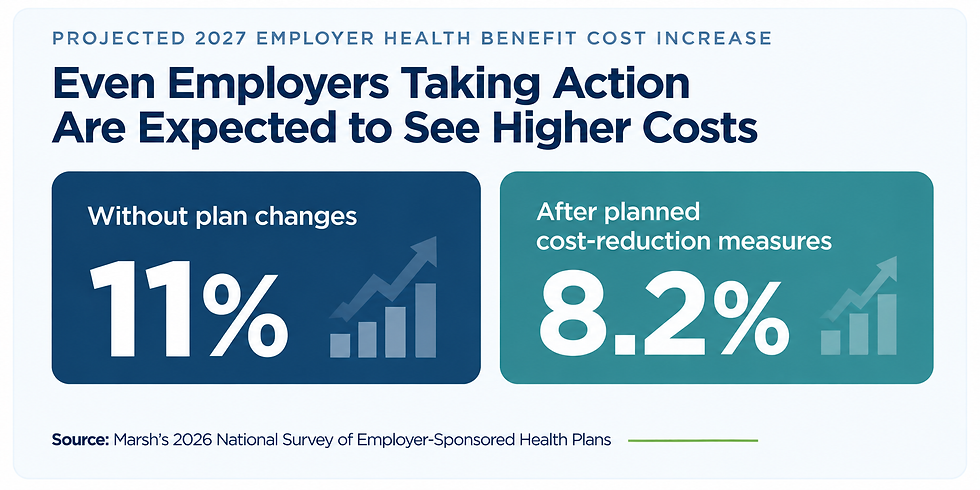
In fact, Marsh’s 2026 National Survey of Employer-Sponsored Health Plans preliminary results show:
And there are signs that the pressure isn’t going away. So, what’s driving employer health insurance costs higher and what can businesses do about it?
Why Are Employer Health Insurance Costs Rising?
There isn’t one simple cause. Several forces are putting pressure on healthcare spending at the same time.
Medical Care and Treatments Are Becoming More Expensive
Advances in medicine can produce better outcomes for patients, but newer diagnostics, specialty treatments and other areas of care can also increase health plan costs.
Marsh has identified advances in diagnostics and therapeutics, including cancer treatments, as one factor contributing to higher costs. It also points to consolidation among healthcare providers, which can increase providers’ bargaining power when negotiating prices with insurers, as well as the growing use of AI-enabled software that assists physicians with claims submission and can result in more—and higher-level—claims being submitted for payment.
For employers, these trends can eventually show up in higher plan costs.
Prescription Drug Costs Are Climbing
Prescription drugs are another significant source of cost pressure.
One particularly important factor is the growing use of GLP-1 medications for weight management. According to Marsh, its actuaries estimate that rising GLP-1 utilization alone accounts for a full percentage point of projected health benefit cost growth in 2027.
The challenge isn’t that new medications don’t provide value. Many do. The challenge for employers is finding a sustainable way to provide meaningful benefits as the cost and utilization of some treatments rise.
Smaller Businesses Can Face an Additional Affordability Challenge
Small and mid-sized businesses don’t necessarily experience employee health benefits in the same way as larger employers.
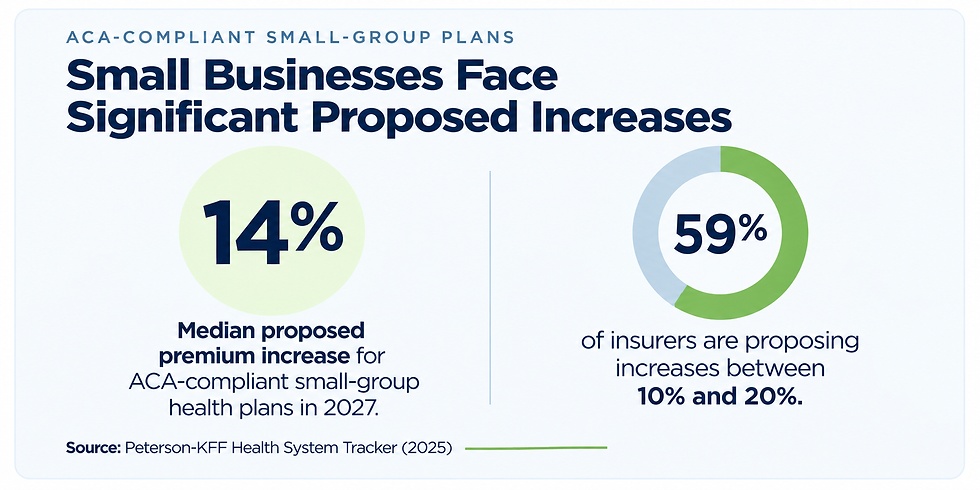
And the outlook for the smallest businesses is particularly challenging. Insurers in the ACA-compliant small-group market are proposing a median premium increase of 14% for 2027, with 59% of insurers proposing increases between 10% and 20%.
These are proposed—not final—rates, and actual increases will vary, but they provide another indication of the cost pressures facing small employers.
Affordability is also an issue for employees. KFF found that workers with family coverage at firms with 10 to 199 employees contributed an average of 36% of the family premium in 2025.
For employees, that’s a meaningful burden. For employers competing for talent, it can be a meaningful challenge too.
Passing More Costs to Employees Isn’t Always the Answer
When premiums increase, employers have several obvious options: absorb more of the increase, raise employee contributions, increase deductibles or change coverage.
But continually shifting costs to employees can create a different affordability problem.
A health benefit may look competitive on paper, but employees ultimately care about whether they can afford both the coverage and the healthcare they need.
Instead of asking only: “How can we make our health insurance cheaper?”
Consider asking: “How can we provide meaningful healthcare benefits at a cost our business can sustain?” That question can lead to a very different conversation.
Explore Alternatives to the Traditional Approach
Employers may have more options than they realize and a growing number appear ready to consider them.
Faced with rising costs, employers are looking beyond traditional cost-shifting and exploring different plan designs, more transparency into healthcare spending, quality-focused options and other approaches to managing costs.
The right approach will vary based on workforce size, employee needs, geography, budget and the employer’s particular circumstances. Instead of treating renewal as a choice between accepting the increase or cutting benefits, use it as an opportunity to evaluate whether another approach could better fit your business and workforce.
The objective isn’t just to spend less. It’s to spend more effectively.
Before Your Next Renewal, Ask More Questions
It's increasingly important to understand your options before renewal, not after the new rates arrive. Start by asking:
Why are our costs increasing?
Are employees getting enough value from what we’re spending?
Have we explored all of the options available to us?
Could we manage healthcare and other workforce services more efficiently?
If we were choosing our benefits strategy today, would we make the same choices?
With employer health insurance costs continuing to rise, automatically renewing the same approach year after year may not be the best strategy. There is a better way.
Explore Your Options with TeamREX
Rather than treating healthcare benefits, payroll and workforce administration as completely separate challenges, TeamREX takes a more connected approach to workforce solutions.
That includes helping employers explore healthcare and benefits options alongside services such as payroll, benefits administration, workers’ compensation and other workforce support.
If rising healthcare costs are putting pressure on your business, TeamREX can help you take a fresh look at what’s available.
Sources & References
Peterson-KFF Health System Tracker. How Much and Why Premiums Are Going Up for Small Businesses in 2027.
Analysis of proposed 2027 premium increases in the ACA-compliant small-group insurance market.
Peterson-KFF Health System Tracker. How Much and Why Premiums Are Going Up for Small Businesses in 2027.Analysis of proposed 2027 premium increases in the ACA-compliant small-group insurance market. View the Peterson-KFF analysis
Comments